Skip to content

Exam simulation Flight Planning and Monitoring - ATPL - Airline Transport Pilot license

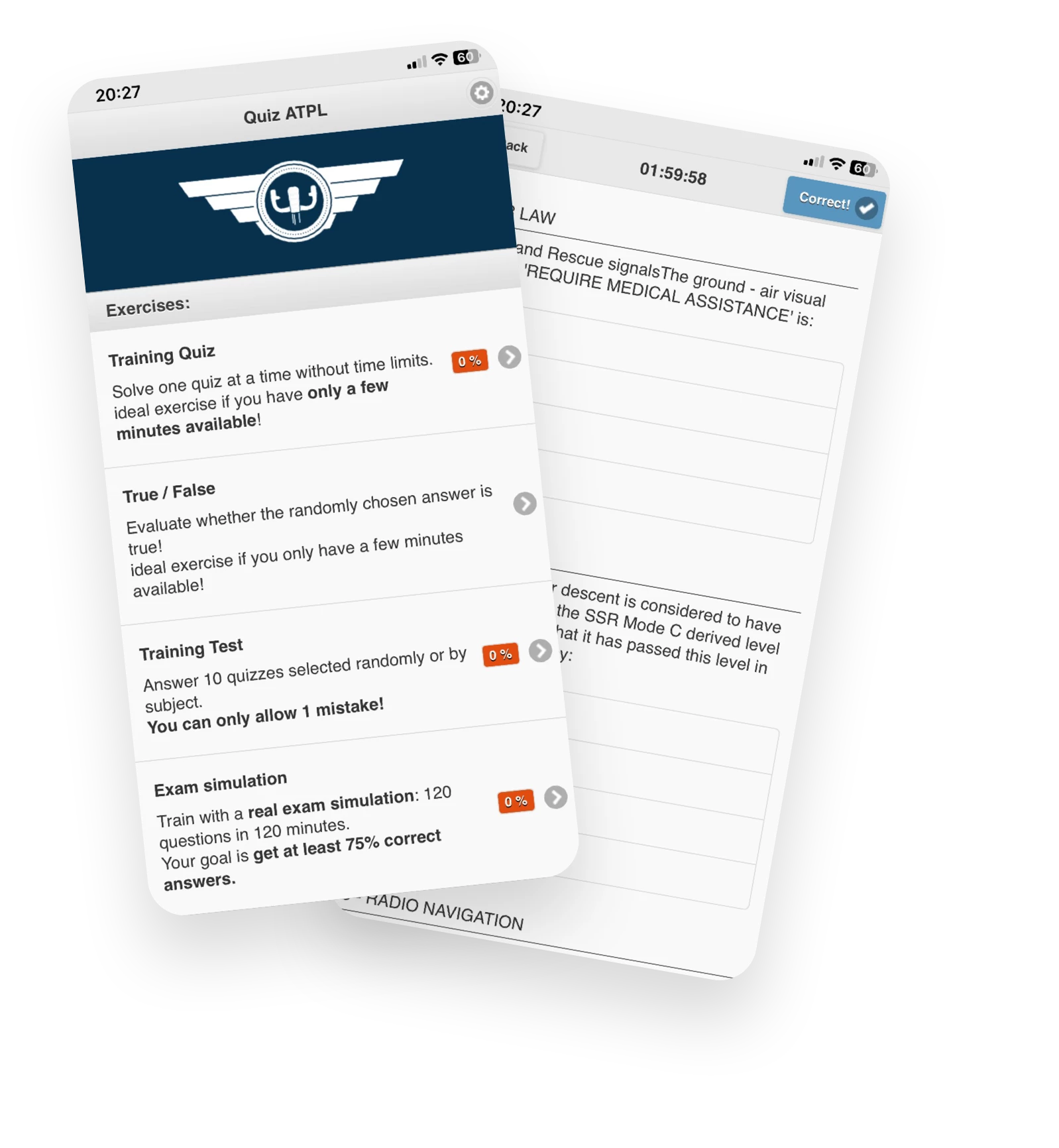
Exam simulation ATPL Flight Planning and Monitoring 120 questions on 120 minutes

1 - Refer to the Student Pilot Route Manual - North Atlantic Plotting Chart. On a direct great circle course from Shannon (5243N 00853W) to Gander (4854N 05432W), the (a) average true course, and (b) distance, are:
question fp20.webp
2 - Minimum planned take-off fuel is 160 kg (30% total reserve fuel is included). Assume the groundspeed on this trip is constant. When the aircraft has done half the distance the remaining fuel is 70 kg. Is diversion to a nearby alternate necessary?
3 - Given: Maximum allowable take-off mass 64.400 kg; maximum landing mass 56.200 kg; maximum zero fuel mass 53.000 kg; dry operating mass 35.500 kg; estimated load 14.500 kg; estimated trip fuel 4.900 kg; minimum take-off fuel 7.400 kg. Find: maximum additional load
4 - An aircraft has a maximum certificated take-off mass of 137000 kg but is operating at take-off mass 135000 kg. In Item 9 of the ATC flight plan its wake turbulence category is:
question fp37.webp
5 - Refer to the General Student Pilot Route Manual - VFR Chart ED-4. Flying VFR from VILLINGEN (48°03.5'N, 008°27.0'E) to FREUDENSTADT (48°28.0'N, 008°24.0'E) determine the magnetic course.
question fp2.webp
6 - Refer to the General Student Pilot Route Manual - VFR Chart ED-4: Flying from SAULGAU airport (48°02'N, 009°31'E) to ALTENSTADT airport (47°50'N, 010°53'E). Find magnetic course and the distance.
question fp16.webp
7 - In the ATC flight plan Item 15, for a flight along a designated route, where the departure aerodrome is not on or connected to that route:
question fp36.webp
8 - The lowest cloud conditions (oktas/ft) at BORDEAUX/MERIGNAC at 1330 UTC were
question 033-12331A.webp
9 - The maximum permissible take-off mass of an aircraft for the L wake turbulence category on an ATC flight plan is:
10 - Given: Distance from departure to destination 1860 NM GS Out 360 kt GS Home 400 kt. What is the time of the PET from the departure point?
11 - Refer to Performance Manual MRJT1 Figures 4.5.2 and 4.5.3.4 Given: Distance C - D: 540 NM Cruise 300 KIAS at FL 210 Temperature Deviation from ISA: +20°C Headwind component: 50 kt Gross mass at C: 60 000 kg. The fuel required from C to D is:
question fp53.webp
12 - General Student Pilot Route Manual - VFR Chart ED-4 Flying from Position SIGMARINGEN (48°05'N, 009°13'E) to BIBERACH airport (48°07'N, 009°46'E). Find magnetic course and the distance.
question fp18.webp
13 - How many hours in advance of EOBT should a ATC flight plan be filed in the case of flights into areas subject to air traffic flow management (ATFM)?
14 - Given: Distance from departure to destination 140 NM GS Out 90 kt GS Home 80 kt What is the distance of the PET from the departure point?
15 - Given: Distance from departure to destination: 210 NM Endurance: 2,5 h True Track: 035 W/V: 250/20 TAS: 105 kt. What is the distance of the PSR from the departure point?
16 - During a VFR flight at a navigational checkpoint the remaining usable fuel in tanks is 60 US gallons. The reserve fuel is 12 US gallons. According to the flight plan the remaining flight time is 1h35min. Calculate the highest acceptable rate of consumption possible for the rest of the trip.
17 - Given: Dry operating mass (DOM)= 33000 kg Traffic Load= 8110 kg. Final reserve fuel= 983 kg Alternate fuel= 1100 kg Contingency fuel 102 kg. The estimated landing mass at alternate should be:
18 - True Air speed: 170 kt. Wind in the area: 270°/40 kt. According to the attached the navigation log, an aircraft performs a turn overhead BULEN to re-route to ARD via TGJ. The given wind conditions remaining constant. The fuel consumption during the turn is 20 litres. The total fuel consumption at position overhead ARD will be:
question fp32.webp
19 - In the ATC flight plan Item 19, emergency and survival equipment carried on the flight should be indicated by:
question fp43.webp
20 - When completing an ATC flight plan for a flight commencing under IFR but possibly changing to VFR, the letters entered in Item 8 (FLIGHT RULES) would be:
21 - The required time for final reserve fuel for turbojet aeroplane is:
22 - In an ATC flight plan Item 15 (route), in terms of latitude and longitude, a significant point at 41°35' north 4°15' east should be entered as:
23 - Refer to 5AT(HI): On airway PTS P from Vigra (62°33'N 006°02'E), the initial great circle grid course is:
question fp19.webp
24 - A minimum sector altitude (MSA) is defined in relation to a radio navigation facility. Unless a different distance is specified, this altitude is valid within:
25 - An aircraft, following a 215° true track at variation 3°W, must fly over a 10 600 ft obstacle with a minimum obstacle clearance of 1 500 ft. Knowing the QNH received from an airport close by, which is almost at sea-level, is 1035 and the temperature is ISA -15°C, the minimum flight level will be:
26 - What is the mean temperature deviation (°C) from the ISA over 50°N 010°W?
question 033-11190A.webp
27 - The fuel plan gives a trip fuel of 65 US gallons. The alternate fuel, final reserve included, is 17 US gallons. Contingency fuel is 5% of the trip fuel. The usable fuel at departure is 93 US gallons. At a certain moment the fuel consumed according to the fuel gauges is 40 US gallons and the distance flown is half of the total distance. Assume that fuel consumption doesn't change. Which statement is right?
28 - In the vicinity of SHANNON (52° N 009°W) the tropopause is at about FL
question 033-12320A.webp
29 - An aircraft is flying at Mach 0.84 at FL 330. The static air temperature is -48°C and the headwind component 52 kt. At 1338 UTC the controller requests the pilot to cross the meridian of 030W at 1500 UTC. Given the distance to go is 570 NM, the reduced Mach No. should be:
30 - Refer to the Student Pilot Route Manual: E LO 2 An appropriate flight level for flight on airway B3 from CHATILLON CTL 117.6 (49°08'N 003°35'E) to CAMBRAI CMB 112.6 (50°14'N 003°09'E) is:
question fp48.webp
31 - Given: Distance from departure to destination: 330 NM Endurance: 5 h True Track: 170 W/V: 140/25 TAS: 125 kt. What is the distance of the PSR from the departure point?
32 - Refer to Student Pilot Route Manual Amsterdam, Schiphol (Plate 10- 3): Which of the following statements is correct for ANDIK departures from runway 19L?
question 033-11048A.webp
33 - In an ATC flight plan Item 15, in order to define a position as a bearing and distance from a VOR, the group of figures should consist of:
34 - When filling in an ATC flight plan before departure, the time information which should be entered in item 13: 'Time' is:
question fp33.webp
35 - The true course is 042°. The variation in the area is 6° W and the wind is calm. The deviation card is reproduced in the annex. In order to follow this course, the pilot must fly a compass heading of:
question fp9.webp
36 - Which is the heaviest type of precipitation, if any, forecast for BORDEAUX/MERIGNAC at 1000 UTC?
question 033-12335A.webp
37 - Refer to the General Student Pilot Route Manual - VFR Chart ED-4. An aeroplane is flying VFR and approaching position TANGO VORTAC (48°37'N, 009°16'E) at FL 055 and magnetic course 090°, distance from VORTAC TANGO 20 NM. What is the frequency of the TANGO VORTAC.
question fp1.webp
38 - Which of the following statements is (are) correct with regard to the advantages of computer flight plans? 1. The computer can file the ATC flight plan. 2. Wind data used by the computer is always more up-to-date than that available to the pilot.
39 - Given: Distance from departure to destination: 210 NM Endurance: 3,5 h True Track: 310 W/V: 270/30 TAS: 120 kt What is the distance of the PSR from the departure point?
40 - Refer to the General Student Pilot Route Manual - VFR Chart ED-4. Flying VFR from VILLINGEN (48°03.5'N, 008°27.0'E) to FREUDENSTADT (48°28.0'N, 008°24.0'E) determine the distance.
question fp3.webp
41 - For turbojet engine driven aeroplane, given: Taxi fuel 600 kg. Fuel flow for cruise 10000 kg/h. Fuel flow for holding 8000 kg/h. Alternate fuel 10200 kg. Planned flight time to destination 6 h. Forecast visibility at destination 2000 m. The minimum ramp fuel required is:
42 - An aircraft is in cruising flight at FL 095, GS 155 kt. The pilot intends to descend at 500 fpm to arrive overhead the MAN VOR at 2000' (QNH 1030 hPa). The TAS remains constant in the descent, wind is negligible, temperature standard. At which distance from MAN should the pilot commence the descent?
43 - For an ATC flight plan filed before the flight, the indicated time of departure is:
44 - Refer to the General Student Pilot Route Manual - VFR Chart ED-4. Which navigation aid is located in position 48°30'N, 007°34'E?
question fp15.webp
45 - Excluding RVSM an appropriate flight level for IFR flight in accordance with semi-circular height rules on a magnetic course of 200° is:
46 - During a flight the fuel indicators show that the remaining amount of fuel is 100 lbs after 38 minutes. The total amount of fuel at departure was 160 lbs. For the alternate fuel, 30 lbs is necessary. The planned fuel for taxi is 13 lbs. Final reserve fuel is estimated at 50 lbs. If the fuel flow remains the same, how many minutes can be flown to the destination with the remaining fuel?
47 - For a planned flight the calculated fuel is as follows: Flight time: 2h42min The reserve fuel, at any time, should not be less than 30% of the remaining trip fuel. Taxi fuel: 9 kg Block fuel: 136 kg How much fuel should remain after 2 hours flight time?
48 - You are flying a constant compass heading of 252°. Variation is 22°E, deviation is 3°W and your INS is showing a drift of 9° right. True track is?
49 - After flying for 16 min at 100 kt TAS with a 20 kt tail wind component, you have to return to the airfield of departure. You will arrive after:
50 - In the ATC flight plan Item 15, a cruising speed of 470 knots will be entered as:
question fp25.webp
51 - The planned departure time from the parking area is 1815 UTC. The estimated take-off time is 1825 UTC. The flight plan must be filed with ATC at the latest at:
52 - On a given path, it is possible to choose between four flight levels (FL), each associated with a mandatory flight Mach Number (M). The flight conditions, static air temperature (SAT) and headwind component (HWC) are given below: FL 370 - M = 0.80 Ts = -60°C HWC = -15 kt. FL 330 - M = 0.78 Ts = -60°C HWC= - 5 kt. FL 290 - M = 0.80 Ts = -55°C HWC = -15 kt. FL 270 - M = 0.76 Ts = -43°C HWC = 0. The flight level allowing the highest ground speed is:
53 - An aircraft flies at a TAS of 380 kt. It flies from A to B and back to distance AB = 480 NM. When going from A to B, it experiences a headwind component = 60 kt. The wind remains constant. The duration of the flight will be:
54 - A flight has to be made with a multi engine piston aeroplane (MEP 1 Fig. 3. 3). For the fuel calculations take 5 US gallons for the taxi, and an additional 13 minutes at cruise condition to account for climb and descent. Calculated time overhead to overhead is 2h37min. Power setting is 65%, 2500 RPM. Calculated reserve fuel is 30% of the trip fuel. FL 120. Temperature 1°C. Find the minimum block fuel.
question fp24.webp
55 - Given: maximum allowable take-off mass 64400 kg maximum landing mass 56200 kg maximum zero fuel mass 53000 kg dry operating mass 35500 kg estimated load 14500 kg estimated trip fuel 4900 kg minimum take-off fuel 7400 kg Find the maximum allowable take-off fuel:
56 - For the purposes of Item 9 (Wake turbulence category) of the ATC flight plan, an aircraft with a maximum certificated take-off mass of 62000 kg is:
question fp38.webp
57 - In the ATC flight plan Item 19, if the number of passengers to be carried is not known when the plan is ready for filing:
58 - Refer to the General Student Pilot Route Manual - VFR Chart ED-4 Flying VFR from PEITING (47°48.0'N, 010°55.5'E) to IMMENSTADT (47°33.5'N, 010°13.0'E) determine the distance.
question fp6.webp
59 - You are to determine the maximum fuel load which can be carried in the following conditions: - dry operating mass: 2800 kg - trip fuel: 300 kg - traffic load: 400 kg - maximum take-off mass: 4200 kg - maximum landing mass: 3700 kg
60 - Find the time to the Point of Safe Return (PSR). Given: Maximum useable fuel 15000 kg, Minimum reserve fuel 3500 kg, TAS out 425 kt, Head wind component out 30 kt, TAS return 430 kt, Tailwind component return 20 kt, Average fuel flow 2150 kg/h
61 - Refer to the Student Pilot Route Manual - PARIS CDG Plate 20-3: Planning an IFR-flight from Paris (Charles de Gaulle) RWY 27 to London. Given: Distance from PARIS Charles-de-Gaulle to top of climb 50 NM Determine the distance from the top of climb (TOC) to ABB 116.6.
question fp51.webp
62 - See Flight planning Manual SEP 1 Figure 2.3 Table 2.3.1. Using the Power Setting Table, for the single engine aeroplane, determine the cruise TAS and fuel flow (lbs/hr) with full throttle and cruise lean mixture in the following conditions. Given: OAT: 3°C; Pressure altitude: 6000 ft; Power: Full throttle / 21,0 in/Hg./ 2100 RPM
question fp30.webp
63 - Refer to Performance Manual SEP1 Figure 2.1 Time, Fuel and Distance to Climb. Given: take-off mass 3 500 lb, departure aerodrome pressure altitude 2 500 ft, OAT +10°C, first cruising level FL 140, OAT -5°C. Find the time, fuel and still-air distance to climb.
question fp52.webp
64 - Refer to the Student Pilot Route Manual - VFR Chart ED-4 Flying from ERBACH airport (48°21'N, 009°55'E) to POLTRINGEN airport (48°33'N, 008°57'E). Find magnetic course and the distance.
question fp17.webp
65 - Refer to the Student Pilot Route Manual, Paris Charles-de-Gaulle (Plate 20-2): The route distance from CHIEVRES (CIV) to BOURSONNE (BSN) is:
question 033-11043A.webp
66 - The W/V (°/kt) at 60° N 015° W is
question fp28.webp
67 - The still-air distance in the climb is 189 Nautical Air Miles (NAM) and time 30 minutes. What ground distance would be covered in a 30 kt head wind?
68 - For a planned flight the calculated fuel is as follows: Flight time: 3h06min The reserve fuel, at any time, should not be less than 30% of the remaining trip fuel. Taxi fuel: 8 kg Block fuel: 118 kg How much fuel should remain after 2 hours flight time?
69 - Refer to the General Student Pilot Route Manual - VFR Chart ED-4. Give the frequency of ZURICH VOLMET.
question fp12.webp
70 - Given: Dry operating mass (DOM)= 33510 kg Traffic Load= 7600 kg. Final reserve fuel= 983 kg Alternate fuel= 1100 kg Contingency fuel 102 kg. The estimated landing mass at alternate should be:
71 - Refer to the General Student Pilot Route Manual ED-4: Flying VFR from PEITING (47°48.0'N, 010°55.5'E) to IMMENSTADT (47°33.5'N, 010°13.0'E). Determine the minimum altitude within a corridor 5 NM left and 5 NM right of the course line in order to stay 1000 ft clear of obstacles.
question fp7.webp
72 - In the ATC flight plan Item 10 (equipment), the letter to indicate the carriage of a serviceable transponder - mode A (4 digits-4096 codes) and mode C, is:
question fp46.webp
73 - Which of the following statements is (are) correct with regard to computer flight plans 1. The computer takes account of bad weather on the route and adds extra fuel. 2. The computer calculates alternate fuel sufficient for a missed approach, climb, cruise, descent and approach and landing at the destination alternate.
74 - Refer to Performance Manual MRJT1 Page 13 Figure 4.3.3C Simplified Flight Planning - Trip Distances Given: ground distance to destination aerodrome 1600 NM headwind component 50 kt FL 330 cruise 0.78 Mach ISA +20 °C estimated landing weight 55000 kg. Find: simplified flight planning to determine estimated trip fuel and trip time.
question 433c.webp
75 - Given: True course (TC) 017°, W/V 340°/30 kt, True air speed (TAS) 420 kt Find: Wind correction angle (WCA) and ground speed (GS)
76 - Refer to Performance Manual MRJT1 Figure 4.7.2 (One Engine Inop): An aircraft on an extended range operation is required never to be more than 120 minutes from an alternate, based on 1 engine inoperative LRC conditions in ISA. Using the above table and a given mass of 40000 kg at the most critical point, the maximum air distance to the relevant alternate is:
question img472.webp
77 - Item 9 of the ATC flight plan includes 'NUMBER AND TYPE OF AIRCRAFT'. In this case 'NUMBER' means:
question fp40.webp
78 - Refer to Performance Manual MRJT1 Page 21 Figure 4.5.1 En-route Climb 280/0.74 (continued) Find: Time, Fuel, Still-Air Distance and TAS for an enroute climb 280/.74 to FL 350. Given: Brake release mass 64000 kg, ISA +10°C, airport elevation 3000'
question 451.webp
79 - Refer to the General Student Pilot Route Manual - VFR Chart ED-4 Flying VFR from PEITING (47°48.0'N, 010°55.5'E) to IMMENSTADT (47°33.5'N, 010°13.0'E) determine the magnetic course.
question fp5.webp
80 - The maximum wind velocity (°/kt) shown in the vicinity of MUNICH (48°N 012°E) is:
question fp26.webp
81 - In the ATC flight plan item 7, for a radio equipped aircraft, the identifier must always:
question fp42.webp
82 - See TRM (VFR), Aberdeen (Dyce) Information Page (19-6). What is the designated departure route when using Runway 23 in bad weather and/or low visibility?
83 - From which of the following would you expect to find facilitation information regarding customs and health formalities?
84 - The planned flight is over a distance of 440 NM. Based on the wind charts at altitude the following components are found: FL50: -30kt, FL100: -50kt, FL180: -70kt. The Operations Manual in appendix details the aircraft's performances. Which of the following flight levels (FL) gives the best range performance:
question fp8.webp
85 - During climb to cruising level, the zero-wind time is 36 min and the zero-wind distance travelled is 157 NM. What distance will be travelled with an average tailwind component of 60 kt?
86 - Given: Distance from departure to destination: 2000 NM Endurance: 5 h TAS: 500 kt Ground Speed Out: 480 kt Ground Speed Home: 520 kt. What is the distance of the PSR from the departure point?
87 - The final reserve fuel for aeroplanes with turbine engines is
88 - When completing an ATC flight plan, an elapsed time (Item 16) of 1 hour 55 minutes should be entered as:
question fp41.webp
89 - Refer to the Student Pilot Route Manual - VFR Chart ED-4 Flying VFR from VILLINGEN (48°03.5'N, 008°27.0'E) to FREUDENSTADT (48°28.0'N, 008°24.0'E). Determine the minimum altitude within a corridor 5 NM left and 5 NM right of the course line in order to stay 1000 ft clear of obstacles.
question fp4.webp
90 - If your destination airport has no ICAO indicator, in the appropriate box of your ATC flight plan, you write:
91 - Given: Distance from departure to destination 95 NM True track 105 W/V 060/15 TAS 140 kt What is the distance of the PET from the departure point?
92 - A 'current flight plan' is a:
93 - What lowest cloud conditions (oktas/ft) are forecast for JOHANNESBURG/JAN SMUTS at 0300 UTC?
question 033-12329A.webp
94 - In the ATC flight plan item 15, when entering a route for which standard departure (SID) and standard arrival (STAR) procedures exist:
95 - Refer to Performance Manual MRJT1 Page 75 Figure 4.7.2 Area of Operation - Diversion Distance One Engine Inoperative Using the above table, in ISA conditions and at a speed of M.70/280KIAS, in an elapsed time of 90 minutes an aircraft with mass at point of diversion 48000 kg could divert a distance of:
question img472.webp
96 - Given: Distance from departure to destination: 3750 NM Endurance: 9,5 h True Track: 360 W/V: 360/50 TAS: 480 kt What is the distance of the PSR from the departure point?
97 - Given: Distance from departure to destination 338 NM True track 045 W/V 225/35 TAS 120 kt What is the distance and time of the PET from the departure point? What is the distance and time of the PET from the departure point?
98 - Given: Distance from departure to destination 2800 NM True track 140 W/V 140/100 TAS 500 kt What is the distance and time of the PET from the departure point?
99 - Refer to the Student Pilot Route Manual - E HI 2. An aircraft has to fly on airways from SVEDA (56°10'N 012°34'E) to SKARA (58°23'N 013°15'E). Which of the following is the correct route?
question fp47.webp
100 - The ILS frequency and identifier for RWY 26R are:
question 033-11064A.webp
101 - In an ATC flight plan, Item 15 (route), a cruising pressure altitude of 32000 feet would be entered as:
question fp44.webp
102 - Find: Air distance in Nautical Air Miles (NAM) for this leg and fuel consumption. Given: Flight time from top of climb at FL 280 to the enroute point is 48 minutes. Cruise procedure is long range cruise. Temperature is ISA -5°C. The take-off mass is 56000 kg and climb fuel 1100 kg.
question 033-508.webp
103 - Refer to Figure 4.7.3 Given: Diversion distance 720 NM Tail wind component 25 kt. Mass at point of diversion 55000 kg Temperature ISA Diversion fuel available 4250 kg. What is the minimum pressure altitude at which the above conditions may be met?
question 473.webp
104 - How many feet you have to climb to reach FL 75? Given: FL 75 departure aerodrome elevation 1500' QNH = 1023 hPa temperature = ISA 1 hPa = 30'
105 - A commercial air transport aeroplane with reciprocating engines, the final reserve should be:
106 - What mean temperature (°C) is likely on a course of 360° (T) from 40°N to 50°N at 040°E?
question fp27.webp
107 - A repetitive flight plan (RPL) is filed for a scheduled flight: Paris-Orly to Angouleme, Paris Orly as alternate. Following heavy snow falls, Angouleme airport will be closed at the expected time of arrival. The airline decides before departure to plan a re-routing of that flight to Limoges.
108 - What is the worst hazard, if any, that could be associated with the type of feature at 38°N 015°E?
question 033-11181A.webp
109 - Refer to Performance Manual MRJT1 Page 19 Figure 4.5.1 En-route Climb 280/0.74 Given: brake release mass 57500 kg temperature ISA -10°C headwind component 16 kt initial FL 280 Find: still-air distance (NAM) and ground distance (NGM) for the climb
question 451.webp
110 - Refer to Performance Manual MRJT1 Figure 4.5.4 (Descent) A descent is planned at.74/250KIAS from 35000 ft to 5000 ft. How much fuel will be consumed during this descent?
question 454a.webp
111 - A sector distance is 450 NM long. The TAS is 460 kt. The wind component is 50 kt tailwind. What is the still-air distance?
112 - Refer to General Student Pilot Route Manual: In the ATC flight plan Item 10, 'standard equipment' is considered to be:
question fp35.webp
113 - What is the temperature deviation (°C) from ISA over 50° N 010°E?
question fp54.webp
114 - When completing an ATC flight plan for a European destination, clock times are to be expressed in:
115 - An aeroplane has the following masses: ESTLWT= 50.000 kg; Trip fuel= 4.300 kg; Contingency fuel= 215 kg; Alternate fuel (final reserve included)= 2.100 kg Taxi= 500 kg; Block fuel= 7.115 kg; Before departure the captain orders to make the block fuel 9.000 kg. The trip fuel in the operational flight plan should read:
116 - Refer to the General Student Pilot Route Manual - VFR Chart ED-4. Give the name and frequency of the Flight Information Service for an aeroplane in position (47°59'N, 010°14'E) at 5000'.
question fp10.webp
117 - Given: Distance from departure to destination: 400 NM Endurance: 2,5 h TAS: 115 kt Ground Speed Out: 130 kt Ground Speed Home: 105 kt What is the distance of the PSR from the departure point?
118 - Prior to an IFR flight, when filling in the ATC flight plan, the time information which should be entered in box 16: 'Total estimated time' is the time elapsed from:
question fp34.webp
119 - See Flight Planning Manual SEP 1 Figure 2.5. Given: FL 75, Lean mixture, Full throttle, 2300 RPM. Take-off fuel: 444 lbs, Take-off from MSL. Find: Endurance in hours and minutes.
question fp31.webp
120 - Find the SHORT DISTANCE CRUISE ALTITUDE for the twin jet aeroplane. Given: Brake release mass=45000 kg, Temperature=ISA + 20°C, Trip distance=50 Nautical Air Miles (NAM)
question fig4.2.webp